Circle Rate vs. Market Rate: What Property Buyers in Haryana Should Know
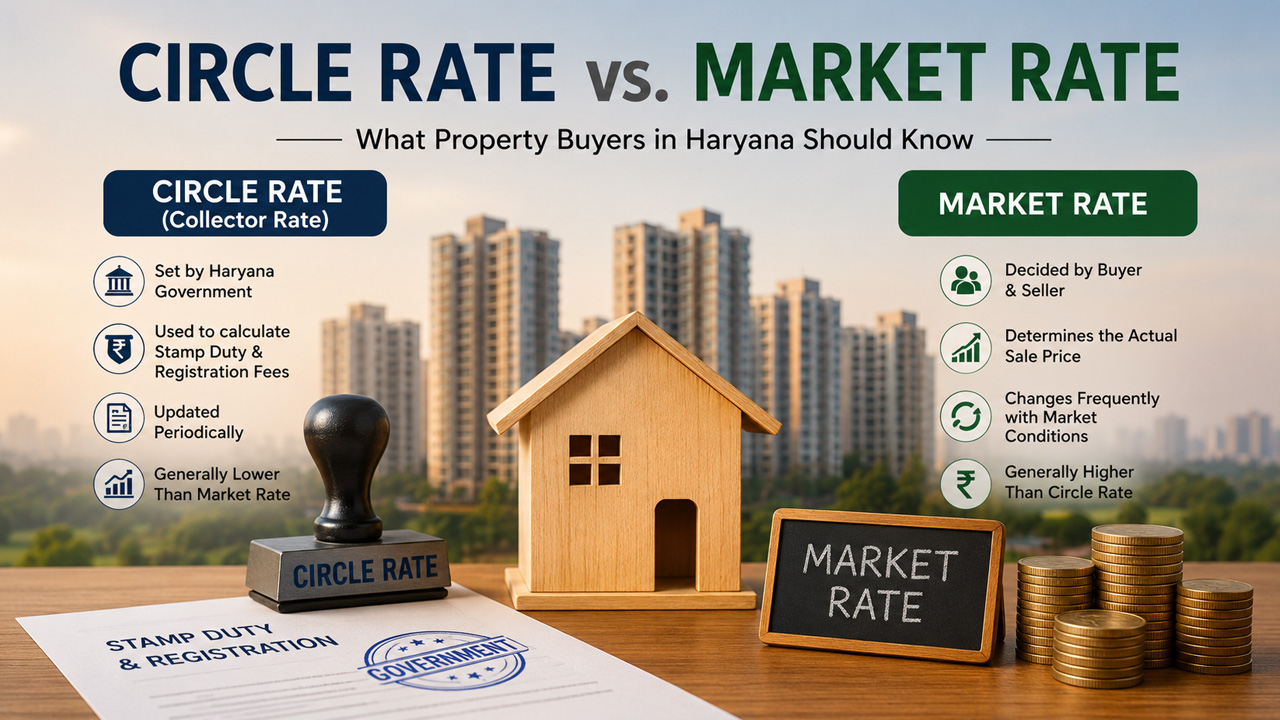
Buying real estate in Haryana is much more complex than just finding a good location. It is necessary to understand the financial and legal implications of each of the cost variables that influence the total purchase price.
Circle Rate and Market Rate are two terms that often perplex customers who wish to buy homes or plots. Although it may seem that these two terms have similar meanings and roles in property pricing, stamp duty, and taxation, the truth is that the role each of these terms plays is very different.
We, at VNS Property, keep our communication as simple as possible to maintain clarity in all our transactions. Commonly asked questions by home-buyers in Haryana are answered here.
What is the Circle Rate?
The Circle Rate, or the Ready Reckoner Rate or Collector Rate in Haryana, is the rate of the minimum price per square yard or per square foot of property set by the Haryana Government for property registrations in any particular region.
Collector rates of different tehsils and sectors are reviewed and changed by the government to reflect the advancement of urban areas. It is the price below which a property cannot be registered at the sub-registrar’s office.
What is the Market Rate?
The Market Rate is the price that a seller sells at, and a buyer buys at, and is agreed upon by both the parties. This price is very volatile, and is influenced by many factors such as the growth of the local area, the development of local infra by the builder, the plot’s location and position, and the surrounding amenities.
Key Differences at a Glance
Factor | Circle Rate (Collector Rate) | Market Rate
Determined By | Haryana Revenue Department / State Govt. | Buyer & Seller negotiations (Market Dynamics)
Primary Function | Baseline to calculate Stamp Duty & Registration Fees | Determines the actual sale amount paid to the seller
Frequency of Change | Periodically updated by district authorities | Changes frequently based on demand & supply
Typical Value | Generally lower than the market rate | Generally higher than the circle rate
Circle Rate vs. Market Rate: What Property Buyers in Haryana Should Know
Property valuation terms can make navigating the real estate market in Haryana, whether one is looking to purchase a luxury apartment on Gurgaon’s Golf Course Road, an industrial plot in Faridabad, or a residential sector in Panchkula, quite confusing. Two specific terms are Circle Rate and Market Rate.
Both terms have their own functions and purposes and knowing them will save you from surprising tax dues, legal problems, or loan shortages. Below are all the terms property buyers in Haryana should know for a stress-free purchase.
What is the Circle Rate?
The Circle Rate (known as the Collector Rate in Haryana) is the minimum price per square yard/foot in the government records used to register a property. These rates, set and revised by the Revenue Department in Haryana, assist in estimating stamp duty and registration charges and, therefore, help the government to earn proper revenue from the transfer of property.
The circle rate varies between cities in Haryana based on the following:
– Micro Markets: Properties in well-established sectors and prime commercial areas have higher collector rates when compared to properties in underdeveloped areas.
– Property Type: Rates differ for residential plots, builder floors, apartments, commercial offices and agricultural land.
– Infrastructure: Improved connectivity to major highways and metro and other civic facilities aid an increase in the official collector rate.
What is the Market Rate?
The Market Rate is the price at which a property sells in the open market. The government regularly updates circle rates, unlike market rates which are more dynamic and change frequently according to demand and supply.
Market rates are affected by the following:
– The Demand-Supply Gap: In fast developing areas such as Sonipat or Gurgaon, market price is much higher than the government value.
– Certain Specific Features: The corner plot, park facing unit, floor level, construction quality, the extent of interior upgrades, and Vastu orientation, influence the market price.
– Promoter Reputation and Construction: Reputable builders will command a premium for their ready to move in homes, above what under-construction projects will attract.
Key Differences: Circle Rate vs. Market Rate
Circle Rate (Collector Rate) is defined by the Revenue Department of Haryana; Market Rate is the price agreed to by the buyer and the seller in the open market. Circle Rate is updated by the Haryana Government once a year, while Market Rate is based on economic conditions and is not as stable. Stamp Duty and Registration Fee are calculated based on Market Rate, while Circle Rate is non-negotiable and is used as a benchmark to calculate the Stamp Duty.
Why the Gap Matters to Buyers in Haryana
In most urban centers of Haryana, the market rate is much higher than the official collector rate. Because of this, buyers need to be aware of this for three important reasons:
1. Stamp Duty and Registration Charges
In the state of Haryana, during the property registration process the agreement value (market rate) and circle rate are evaluated. Since a property cannot be registered for a price below the circle rate, avoiding penalties and fines on under payment of stamp duty is ensured by evaluating registration charges based on the official government rate.
2. Home Loan Eligibility
Before issuing a loan, banks and HFCs (housing finance companies) conduct property valuations. Loan-to-Value (LTV) ratios are generally in the range of 75 percent to 90 percent of the property’s value. If the circle rate is much lower than the deal strike price with the seller, you might face a shortfall in loan approval and be required to make a higher personal contribution.
3. Capital Gains and Tax Effects (Section 50C & Section 56(2)(x))
As per the Income Tax laws of India, the difference between the prescribed circle rate and the rate at which a property is sold, if sold at a price lower than the circle rate, would be the income of the seller and buyer, respectively, and be taxable. In such instances, full compliance with the Income Tax laws would be ensured by the seller and buyer if the transaction is completed at a price of at least the circle rate.
Property Buyer Considerations
– Check For Latest Circular Rates: Before making a token payment, check the latest circular rates on the Jamabandi Haryana official portal to approximate your stamp duty.
– Bridge Capital Gap: There might be a gap between the bank’s loan approval value and the seller’s desired price. You will need to also consider this when making a purchase.
– Ensure Full Financial Transparency: Your investment and compliance with the Income Tax laws would be ensured if the transactions reflect the true value of the agreement and are completed through legal banking channels.